7 min read
Declutter Before Moving: A Practical Order for What Comes Next
 Nikke the SpaceMaker
:
Published
Updated
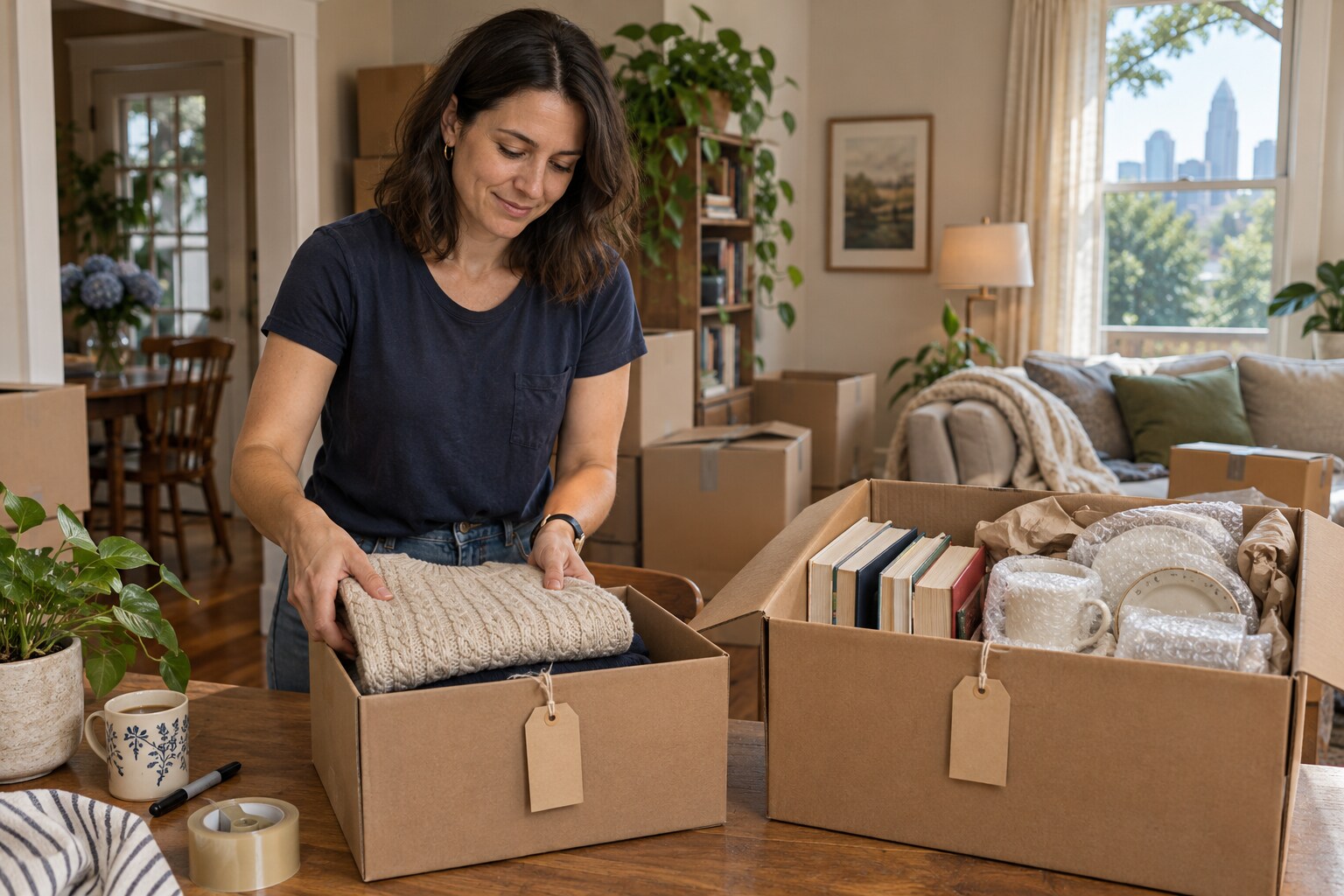
Pack the life you are moving toward, not every unfinished decision from the place you are leaving.
Declutter before moving by confirming what your next home needs, sorting one manageable category at a time, and giving unwanted belongings a real exit plan before packing begins. Start with items you rarely use, protect daily essentials, and leave time for decisions that need other people. The aim is fewer unnecessary moves—not a perfect house before moving day.
Moving has a remarkable ability to make every object ask a question at once. Are we keeping the extra lamp? Does the new place have room for this table? Why do we own three incomplete picnic sets and no matching lids?
You do not need to answer everything today. You need an order that keeps useful progress moving while the rest of life continues. That includes meals, work, rest, and finding the shoes you are actually wearing this week.
Think of pre-move decluttering as choosing what deserves a place in your next chapter. Packing comes afterward. Putting an unresolved decision into a beautiful box is still an unresolved decision, now with tape.
Start with the destination, not the donation pile
Gather the information you have about the new home: room dimensions, available storage, access arrangements, and any restrictions that affect what can be moved or placed there. Mark uncertain details as questions instead of guessing.
List the activities the home needs to support. Cooking, work, hobbies, hosting, and everyday rest may require different space allocations than they do now. A room with the same name is not necessarily the same size or shape.
Use this information to guide decisions rather than impose an arbitrary item count. A frequently used hobby deserves consideration; an unused spare furnishing does not automatically deserve the largest storage area just because it has always had one.
Build three lanes through the project
Separate what can be decided now, what needs more information, and what must remain available until close to departure. These lanes help prevent small uncertainties from stopping the entire move.
The first lane might include duplicate serving pieces, old packing materials, or clothing you have already decided not to wear. The second may include furniture awaiting measurements or shared belongings requiring a conversation. The third contains daily essentials.
Keep the information-needed group bounded. Write the question, the person responsible for answering it, and the next check-in. “Ask whether the desk fits the study” is actionable. “Deal with all the furniture someday” has rather less momentum.
Begin where the decisions are reasonably clear
Choose a modest category with few emotional or logistical complications. Perhaps it is the extra vases, unused outdoor cushions, or a shelf of supplies for an activity you no longer do.
Bring together only what you can safely handle and finish within the available session. Compare duplicates, identify what remains useful, and decide where the retained items will go in the next home.
This is not a contest to find the easiest possible objects forever. It is a way to establish a working process before reaching harder categories. Completing a small, clear decision loop teaches you where the practical obstacles are: missing bags, an unclear donation route, or someone else needing a say.
Keep daily life out of the packing crossfire
Make a written list of what must remain accessible: current clothing, essential toiletries, appropriate food supplies, work materials, documents, and other household necessities. Adapt it to the people and animals in your home.
Place these categories deliberately rather than letting them become scattered exceptions. A clearly identified everyday area is easier to protect than a mental list of things you hope nobody packs.
Do not put medicines, sensitive records, valuable items, or specialized equipment into a generic moving plan without checking their particular handling needs. Follow relevant professional, provider, and manufacturer guidance. Organizing convenience does not replace safe transport or appropriate custody.
Decide furniture with measurements and real use
For a large item, consider its dimensions, intended location, access needs, condition, and actual purpose in the next home. Include room to open doors and drawers and use the piece comfortably.
A floor plan is useful, but it is not the only check. Delivery routes, stairs, elevators, and moving-company requirements may also matter. Ask the appropriate provider to assess issues beyond ordinary room planning.
Avoid keeping an oversized piece solely because it was expensive or accepting a replacement before the old one has an exit route. There may be good reasons to retain it. Make that a conscious decision supported by the new space, not a surprise discovered while the truck is waiting.
Give shared belongings a shared decision process
Identify ownership before sorting. Do not donate another person's belongings because the move feels urgent or because you believe the next home would look better without them.
Set a specific conversation around a defined category. “Can we review these board games tonight?” is easier to answer than “We need to get rid of half our stuff.” Explain the available space and invite the other person's priorities.
For items owned jointly, agree on a practical decision rule and what happens when you disagree. A temporary hold may be reasonable, but it should have a location and a next step. Respectful clarity is more helpful than quietly packing resentment alongside the casserole dishes.
Separate memories from the deadline pressure
Sentimental categories may need a different pace. Choose a small group, allow room for conversation, and avoid treating a difficult day as proof that you are failing at moving.
Consider what you wish to preserve: an object, a story, a photograph, or a connection. Keeping an item can be a thoughtful choice. Recording its meaning can also help distinguish treasured pieces from things retained only because no decision was ever made.
Do not assume a photograph replaces an original or that a relative wants to receive a collection. Ask first. For important family papers and photographs, use the National Archives' family preservation guidance rather than treating every memory as suitable for an ordinary storage bag.
Make exits as concrete as packing plans
Create separate routes for donations, items someone has agreed to receive, sales, recycling, and appropriate disposal. Confirm acceptance and arrangements before taking objects anywhere or promising that a provider will collect them.
Assign each route a person and a time. A donation bag beside the door can still become part of the move when nobody has arranged its departure.
Be realistic about selling. Consider the effort you are willing to spend answering inquiries, arranging collection, and managing items that remain unsold. Set your own decision date and an alternative route. The objective is not to extract the maximum possible value from every object while the rest of the move waits indefinitely.
Keep hazardous and restricted materials outside the ordinary stream
Do not place unfamiliar chemicals, damaged batteries, or other potentially hazardous materials into donation bags or ordinary moving boxes simply to empty a cabinet. Keep labels intact and avoid mixing substances.
Check the EPA's household hazardous waste guidance, local program instructions, and the moving provider's current restrictions. Different materials may need different handling and destinations.
The organizing task here is identifying what needs a specialized route and recording the next action. It is not improvising a disposal method. A separate, appropriately managed decision is better than making a questionable item disappear into an anonymous box.
A practical example: the dining-room cabinet
Imagine a household moving to a home with less dining storage. The cabinet contains everyday dishes, holiday serving pieces, inherited glassware, candles, and two unfinished craft projects.
Rather than emptying the entire room, the household reviews one shelf. Everyday dishes are retained for a known kitchen location. A frequently used serving platter stays. A duplicate is assigned to a confirmed donation route. The inherited glassware gets a separate family conversation, not a rushed verdict.
The craft projects are returned to their owners for a defined decision. Nothing is labeled “miscellaneous dining” merely because it happened to be there. This hypothetical example shows how destination and ownership can guide the work without requiring every decision to be equally easy.
Three optional products for a more orderly move
* Affiliate disclosure: As an Amazon Associate I earn from qualifying purchases. Clicking these links is free. If you make a qualifying purchase, we may earn a commission at no extra cost to you.
Use what you already own when it is appropriate. The following links are ordinary Amazon searches for product categories, not verified individual listings, tested products, or promises about current prices and stock. Compare the actual item, materials, dimensions, and seller before buying.
Reusable moving sorting bags
A durable handled bag can separate a light, suitable category during sorting or hold belongings assigned to a particular destination. Choose one whose construction and stated limits fit the intended contents. Clearly label its purpose so a donation bag is not mistaken for belongings to pack.
A bag is not a substitute for protective packaging, and it should not become an excuse to lift more than you can manage safely. Avoid using it for sharp, fragile, leaking, or otherwise unsuitable items.
Explore reusable moving sorting bags on Amazon (affiliate link*)
Removable room labels
Temporary labels can identify categories, destination rooms, or areas that must remain available. Choose a readable size and test compatibility with the surface according to the product instructions. Removable does not mean harmless on every finish.
Write useful words as well as any color cue. “Keep available: daily dishes” communicates more than an unexplained blue sticker. Delay permanent labeling until the decisions are settled enough to justify it.
Explore removable room labels on Amazon (affiliate link*)
Zippered moving documents pouch
A simple pouch can keep ordinary move-related paperwork together, such as a room list, contact notes, or an unpacking plan. Choose a size that allows papers to lie appropriately without forcing the closure.
Do not assume an ordinary pouch provides security, fire protection, or waterproofing. Sensitive or irreplaceable documents may require a different handling plan. The useful feature is a clear, portable home for appropriate paperwork—not a claim that every important record belongs inside.
Explore zippered moving documents pouch on Amazon (affiliate link*)
Plan the last review instead of another whole-house purge
As packing progresses, set aside time to review only the unresolved categories. Recheck the questions that were waiting on measurements, ownership, or collection arrangements.
Avoid opening entirely new projects near departure unless they are necessary. Your goal at this stage is to close decision loops and protect the move's practical requirements, not reorganize every drawer to an ideal standard.
Record what will travel as a temporary decision and why. A clearly identified item awaiting a specific placement choice is different from several mystery boxes nobody remembers. Give it a reasonable review point after arrival, when you can assess the new home rather than make decisions entirely in the abstract.
Questions about decluttering before a move
Should I declutter everything before I pack anything?
No. You can declutter and pack in coordinated stages. Finish a manageable category, arrange exits for unwanted items, and pack retained belongings that are not needed immediately. Keep daily essentials and unresolved decisions clearly identified instead of mixing them into ordinary boxes.
What should I do when I do not know the new home's exact storage?
Make the decisions supported by the information you have. Separate items whose usefulness is already clear from those that depend on measurements or layout. Record the missing information and avoid purchasing storage products for imagined dimensions.
Is moving a good reason to get rid of sentimental things quickly?
A deadline does not make a personal decision less important. Work through a small group, seek agreement where appropriate, and keep meaningful items deliberately. Do not pressure yourself or another person to make irreversible choices simply to maintain a sorting pace.
What if I run out of time to sell unwanted belongings?
Use the alternative route you chose when listing them, provided that route is appropriate and currently available. Confirm acceptance or collection rather than assuming. A realistic exit plan helps keep unsold items from turning into a last-minute pile that follows you by default.
Leave with decisions you can understand
Choose one category, connect it to the next home, and complete its route: keep, ask, give, sell, recycle, or dispose of appropriately. Then move to the next category with the same clear process.
For hands-on decluttering and moving-preparation organizing in Charlotte, Matthews, Mint Hill, and approved nearby communities, contact Space Revisited to discuss the scope and confirm coverage. Organizing support is separate from transport or hauling unless explicitly arranged. You deserve a move that carries your useful life forward, not every decision you were too tired to make alone.
Related reading
Continue with Finish the Decluttering: A Donation and Discard Plan That Works or Downsizing to a Smaller Home Without Shrinking Your Life.
About Space Revisited
Space Revisited helps homeowners in Charlotte, NC, and surrounding communities create beautiful, functional, and easy-to-maintain spaces. From decluttering and home organizing to practical storage solutions and complete space transformations, we help you make room for what matters.
About Garage Revisited
Garage Revisited by Space Revisited helps homeowners throughout the Charlotte, NC, area reclaim their garages and workshops. From decluttering and cleaning to shelving, storage systems, and functional workspace makeovers, we transform underused spaces into organized environments that work for everyday life.
A little help getting started?
You don’t need a perfectly tidy home—or a complete plan—to begin. Let’s talk about the space you’d like to reclaim and what would make everyday life easier.
Serving Charlotte's metropolitan communities.
YOUR NEXT STEP