 Nikke the SpaceMaker
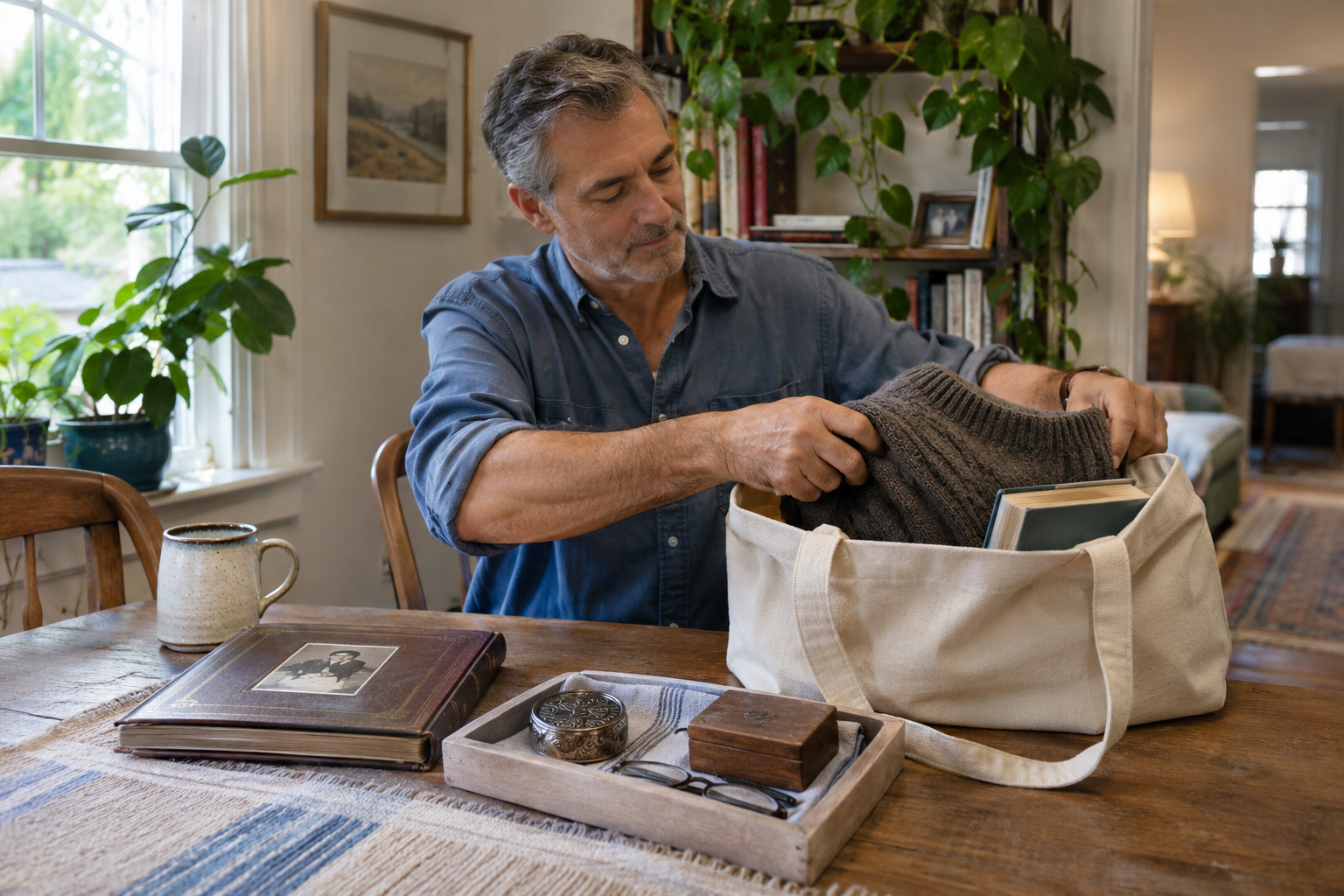
Make thoughtful choices about what stays, what moves, and what is ready for another home—with your preferences in charge.
Decluttering does not require throwing everything away. It means deciding which belongings support your life, making room for them to be used, and choosing appropriate next steps for what no longer fits. You can keep meaningful, useful, and enjoyable things while reducing the confusion around them. The goal is a home that works, not the smallest possible inventory.
There is a particular kind of organizing advice that sounds as though every room should contain a chair, a plant, and one very disciplined spoon.
That may be someone's dream. It does not have to be yours. You are allowed to enjoy books, hobbies, holiday decorations, cooking tools, and the slightly eccentric bowl that makes you happy every time you see it.
The challenge is not that you own things. The challenge is whether your belongings fit the space, attention, and routines available to care for them. A generous, thoughtful decluttering process makes that relationship clearer without treating attachment as a character flaw.
Replace the question “How much can I get rid of?”
Try asking, “What do I want this space to make possible?” A dining table may need to support meals, homework, or conversation. A closet may need to make getting dressed straightforward. A garage may need to support parking and outdoor activities.
That purpose gives your decisions context. An object can be perfectly good and still be in the wrong place. Another object can be used rarely and still deserve a deliberate home because it matters to you.
Do not begin with a percentage you must remove. A numerical target can encourage decisions disconnected from actual use. One crowded drawer might improve when several duplicates leave; another might need a better arrangement rather than fewer items.
Judge the result by access, usefulness, and maintainability. Can you find what you need? Can you put it away without a struggle? Can the room do its main job? Those questions are more personal and more useful than a universal item count.
Keep what you choose, not what escaped a decision
There is a difference between intentionally keeping something and leaving it untouched because deciding feels difficult. Both can look identical on a shelf, but they create different relationships with the space.
Intentional keeping sounds like, “I use these serving dishes for family gatherings, and I am willing to store them here.” Avoided deciding sounds like, “I do not know, so I will put the box behind the other box.”
You do not need to make every decision today. Start by naming what you know you want to keep. Group those belongings and give them suitable space. That can reveal which remaining items need more thought.
For uncertain objects, identify the missing information. Perhaps you need to ask another owner, check whether a part belongs to current equipment, or consider the realistic cost and effort of repair. A named question is easier to resolve than a vague feeling of obligation.
Use categories to understand quantity
Gather a manageable category so you can see what you own. This might be everyday mugs, wrapping supplies, winter scarves, or a specific group of tools. Avoid emptying the whole house to create a grand inventory.
Within the category, distinguish active use, occasional use, sentimental value, and uncertainty. These are ways to think, not permanent labels every object must wear. Some belongings belong in more than one description.
Look for complete, usable sets and notice duplicates. Two items may serve two people or two locations. Several nearly identical items may also be making the useful ones harder to reach. Quantity is a practical question, not an automatic verdict.
Ask how much of the category you can store and maintain comfortably. A collection that fits only when arranged with extraordinary precision may be asking more effort than you want to give it. You can adjust the collection, the location, or the storage after understanding the need.
Let “still good” be one fact, not the entire decision
An item can be in good condition and still no longer serve your household. A coat may not fit, a hobby tool may belong to an interest you have left behind, or an appliance may duplicate something you prefer using.
Keeping every usable object can eventually make your home less usable. That does not mean the object is worthless. It means your available space has limits and priorities.
Consider whether a suitable person or organization could use the item, while checking actual acceptance requirements. Donation is not a way to avoid thinking about condition or suitability. Passing along something responsibly takes a little planning.
You are also allowed to keep a good item deliberately. The point is not to argue yourself out of ownership. It is to make the decision with enough clarity that the object earns a real place rather than an indefinite stay in the hallway.
Give sentimental belongings a different pace
A favorite photograph, inherited object, or keepsake may carry meaning unrelated to frequency of use. Do not force those items through the same questions you use for extra spatulas.
Ask what the object helps you remember and how you would like to care for that connection. Display, appropriate preservation, a smaller curated collection, or a private written note may all be possibilities. None is a universal replacement for the original.
You can keep a sentimental object without keeping every object from the same period of life. You can also postpone a decision when the timing is not right. Put the item in a suitable, clearly identified place rather than leaving it vulnerable in a general sorting pile.
Discuss shared family belongings before making decisions that affect other people. A kind process leaves room for different attachments. It does not require everyone to feel the same way about a collection before any practical progress can happen.
Make room for hobbies without storing every possibility
Hobby supplies often represent enthusiasm, creativity, and a hopeful future afternoon. They deserve a thoughtful look rather than a quick dismissal as clutter.
Separate the hobbies you actively practice from the projects you might someday try. Consider what materials are required for current work and which supplies have been waiting without a realistic plan. The distinction can help you prioritize accessible space.
Give an active hobby a usable working kit and a defined home. A smaller collection that you can find and put away may invite more participation than a large collection buried beneath unrelated supplies.
For future possibilities, decide how much space you want to reserve. A limited shelf or box can hold a few meaningful options without letting every imagined project become a permanent storage obligation. You are choosing room for creativity, not rejecting it.
Use a review box carefully
A review box can help when a small number of ordinary items need time or information. It should not become an unlimited destination for every difficult decision.
Write the reason for review and choose a date or event that will prompt another look. “Check whether these accessories fit the current camera” is more useful than “maybe.” Keep the box accessible enough that the review can actually happen.
Do not place items with safety, preservation, or urgent administrative needs into a casual waiting box. Those require appropriate handling or timely action. A box is not a substitute for addressing a deadline or a hazard.
At review time, make the next decision rather than automatically extending the wait. You may keep the item, find the missing information, or arrange its departure. The box has done its job when it helps a decision move forward, not when it becomes a new category of furniture.
A hypothetical example: the crowded mug cupboard
Imagine a cupboard holding everyday mugs, travel cups, promotional mugs, and a few sentimental pieces. The household enjoys having guests and does not want a minimalist kitchen. The problem is that favorite mugs are difficult to reach.
They begin by identifying the mugs used regularly and the number needed for ordinary hosting. Those receive the easiest access. Travel cups move near the departure routine, where lids and cups can stay together.
A few sentimental mugs remain intentionally, with suitable space. Several unused promotional mugs are considered for an appropriate donation destination. Nothing leaves merely because it is colorful, mismatched, or older than a certain date.
The cupboard works better because the collection has been understood and arranged around use. The household may keep more mugs than someone else would. That is fine. The useful question is whether this household can enjoy and maintain its choices.
Three optional products for thoughtful decisions
* Affiliate disclosure: As an Amazon Associate I earn from qualifying purchases. Clicking these links is free. If you make a qualifying purchase, we may earn a commission at no extra cost to you.
These are product types to consider after identifying a real need. The Amazon links open searches; individual products, availability, prices, and sellers have not been verified. Existing bags, boxes, or labels may be entirely sufficient.
Reusable donation bags
A sturdy bag can keep already-decided donation items together until an appropriate drop-off. Choose a manageable size and use it only for suitable items in acceptable condition. Label the destination or next action, and do not overload it. The bag supports a departure plan; it does not make undecided belongings automatically available for someone else to remove.
Explore reusable donation bags on Amazon (affiliate link*)
Small clear storage boxes
A small box can support a defined retained category or a limited review group. Measure the intended location and consider access, material suitability, and the weight when filled. Avoid buying a large set before you know what needs containing. Clear sides can help with visibility, but the category should still be understandable without opening every box.
Explore clear small storage boxes on Amazon (affiliate link*)
Removable shelf labels
Labels can help protect space for the categories you have deliberately chosen to keep. Use clear, ordinary terms rather than judgments such as “good stuff” or “junk.” Check the attachment method and surface compatibility. A label can make shared storage easier to maintain, but it should describe an agreed arrangement rather than impose decisions on another person's belongings.
Explore removable shelf labels on Amazon (affiliate link*)
Respect limits without turning them into punishment
Every home has limits: physical space, budget, time, access, and the effort available for maintenance. Recognizing those limits does not mean you have failed to appreciate your belongings.
Choose boundaries that support your life. A shelf for an occasional hobby or a box for a certain keepsake category can help you see when a collection needs review. The boundary is a planning tool, not a rule that overrides safety or meaning.
When a category no longer fits, pause before buying more storage. Decide whether the space allocation still reflects your priorities. You may choose to reduce the category, move it, or give it more room by reducing something less important.
The important part is that the tradeoff becomes visible. Keeping more of one thing usually uses space that could serve another purpose. You are allowed to make that choice consciously and without apology.
Let the home remain personal
An organized home can contain color, collections, family history, and objects that do not match. Visual simplicity is one preference, not a universal definition of success.
Some people find visible belongings easier to use; others prefer closed storage. Some enjoy detailed categories; others need broad, forgiving ones. Choose an arrangement that helps the actual users retrieve and return their things.
Do not erase every sign of personality in pursuit of an inspiration image. A favorite collection displayed thoughtfully may be a meaningful use of space. A pile hiding the collection you love may be the part that needs attention.
The aim is to make room for what matters, including the ordinary routines that keep life moving. A home can be both expressive and practical. The extra spoon is welcome, provided you can find the drawer.
Questions about decluttering without extreme minimalism
Do I have to get rid of something every time I buy something?
Not necessarily. A one-in, one-out rule can be a useful personal tool for some categories, but it is not a requirement. Consider the category's capacity, current use, and maintenance needs. The important habit is making an intentional space decision when new belongings arrive.
What if I regret letting something go?
Take decisions at a pace that allows you to consider meaningful or difficult items carefully. No method can guarantee zero regret. Start with clearer decisions, use limited reviews when appropriate, and avoid pressure from helpers to discard belongings you have not chosen to release.
Can I be organized and keep a collection?
Yes. A collection can be organized when it has suitable space, clear access, and a manageable care routine. Consider what you want to display, store, and continue acquiring. The collection should support your enjoyment rather than make the rest of the home difficult to use.
Keep the meaning and reduce the friction
You do not have to become a minimalist to enjoy an organized home. Begin with one category, identify what you genuinely choose to keep, and give those belongings a workable place.
Space Revisited provides a starting conversation about hands-on home organizing in Charlotte, Matthews, Mint Hill, and approved nearby communities. Confirm your address and project scope directly. The goal is not to talk you out of your life. It is to help your home make room for it.
Related reading
Continue with Decluttering Sentimental Items With a Gentle Heart or Finish the Decluttering: A Donation and Discard Plan That Works.
About Space Revisited
Space Revisited helps homeowners in Charlotte, NC, and surrounding communities create beautiful, functional, and easy-to-maintain spaces. From decluttering and home organizing to practical storage solutions and complete space transformations, we help you make room for what matters.
About Garage Revisited
Garage Revisited by Space Revisited helps homeowners throughout the Charlotte, NC, area reclaim their garages and workshops. From decluttering and cleaning to shelving, storage systems, and functional workspace makeovers, we transform underused spaces into organized environments that work for everyday life.
A little help getting started?
You don’t need a perfectly tidy home—or a complete plan—to begin. Let’s talk about the space you’d like to reclaim and what would make everyday life easier.
Serving Charlotte's metropolitan communities.
YOUR NEXT STEP