 Lisa
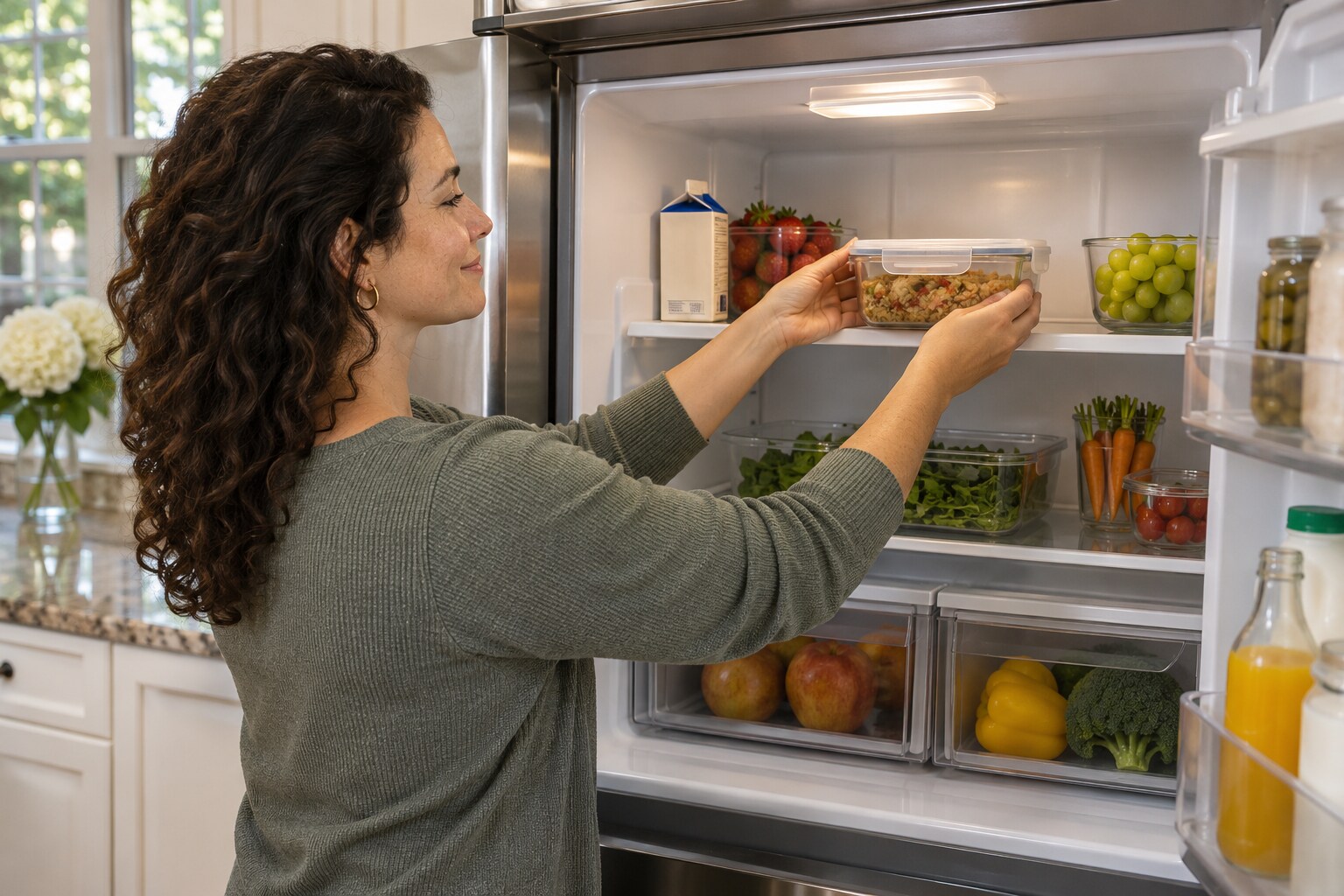
Create useful food zones, readable dates, and space to see what you have—without treating pretty bins as food-safety equipment.
Organize a refrigerator and freezer by keeping food visible, grouping it for practical use, preserving labels and dates, and leaving the appliance able to circulate air as intended. Follow food-safety and manufacturer guidance before choosing bins or rearranging shelves. Good organization supports safe storage; it does not replace temperature control or make questionable food safe.
The refrigerator is one of the busiest storage spaces in the house. It receives new arrivals, holds leftovers, supports rushed lunches, and occasionally conceals a container so thoroughly that opening it feels like an archaeological decision.
A useful fridge is not necessarily a fridge full of identical clear bins. It is a space where you can see what is available, understand what belongs where, and put food away without blocking access or losing important information.
Let’s make the system practical. We will focus on visibility, categories, and a return routine while keeping the appliance's actual job firmly in view: appropriate food storage, not interior decorating.
Begin with safety, not with emptying everything
Plan the work so perishable food is not left out while you undertake a long organizing project. Work in manageable sections and maintain appropriate storage conditions throughout the process.
The FDA's food-storage guidance recommends keeping the refrigerator at 40°F or below and the freezer at 0°F. It also advises using appliance thermometers and avoiding overcrowding that interferes with air circulation.
Do not judge food safety by smell or appearance alone. Follow appropriate guidance for the actual food, packaging, time, and temperature conditions. Organizing decisions should not become guesses about whether a questionable item is safe to eat.
Check your appliance manual before changing shelves, drawers, or door storage. The manufacturer may specify suitable uses and clearances. A layout copied from another refrigerator may not fit the design of yours.
Choose a small section to understand first
Start with one shelf, drawer, or freezer category. Identify what is there and what questions need attention. Keep the food appropriately stored while you work.
Group items by a practical use or compatible category, such as lunch ingredients, breakfast foods, or a defined group of frozen meals. Food-safety needs take priority over convenience, so not every category belongs together simply because it is used in the same meal.
Notice which packages are repeatedly hidden and which areas become crowded after shopping. These are the places where a visibility change may help most.
Avoid creating a full inventory before you understand whether a simple category arrangement would solve the problem. A refrigerator is active storage. Its system needs to handle change without requiring an administrative session every time someone eats yogurt.
Keep important information with the food
Labels, preparation dates, product instructions, and other relevant information should remain available. When food is transferred to an appropriate container, preserve what is needed to identify and manage it responsibly.
Use clear, specific wording rather than a mysterious “leftovers” label when the contents are not obvious. A date should have an understandable meaning, such as the preparation or freezing date, rather than an unexplained number.
Do not treat a handwritten date as a universal safety deadline. Different foods and circumstances require different guidance. The label helps you use the relevant information; it does not create a new storage rule.
Choose labels and writing tools suitable for the container and conditions. Check removability and cleaning instructions. A label that falls off or becomes unreadable can make the system less reliable, especially for similar-looking freezer packages.
Make a visible area for planned use
A small, clearly identified area for foods you have already determined should be used soon can support meal planning. Keep the group limited and follow the appropriate safety guidance for each item.
Do not use this area to collect questionable food in the hope that someone will rescue it. “Use next” means a planning priority, not an exception to safe handling or storage requirements.
Keep the category visible enough that people notice it before opening a new package. A simple shelf position or label may be sufficient; a new bin is optional.
Review the area during ordinary meal planning. When the category becomes full of unrelated items nobody understands, reduce the complexity. The point is to make a useful next meal easier to see, not create a permanent refrigerator waiting room.
Decide whether bins improve or reduce access
A bin can help group small compatible items, but it also uses space and adds another surface to clean. It may improve retrieval in one refrigerator and obstruct it in another.
Measure the usable shelf area and check that the bin does not interfere with vents, drawer movement, door closure, or the appliance's intended air circulation. Follow the appliance and product instructions.
Choose a manageable size. A large bin filled with food may be awkward to lift or remove. Low sides can improve visibility, while higher sides may contain some categories more effectively. The right choice depends on the actual contents.
Do not put every item inside another container merely to create a coordinated look. Original packaging directly on a suitable shelf can be perfectly practical. A refrigerator should not require unpacking three bins to reach one ingredient.
Give the freezer a readable structure
Freezer storage can become difficult when packages are stacked without labels or when several categories are mixed into a deep compartment. Start with the appliance's design and the foods you actually keep.
Group compatible categories in a way that supports retrieval, whether that means upright packages, a suitable basket, or a simple shelf division. Use freezer-appropriate packaging and follow food-storage guidance for the actual items.
Avoid compressing the contents so tightly that packages are difficult to identify or remove. Space used for access is still useful space. A freezer filled to the point of constant rearrangement may need a review of purchasing and use, not another organizing accessory.
For a deeper freezer, a short inventory may help. Keep it limited to information you can maintain, such as the category, approximate quantity, and location. The record should support use without pretending to replace food-safety decisions.
Make meal planning a retrieval test
Before writing a shopping list, look at the visible categories and the items already planned for use. This can help you identify what is available and what is genuinely missing.
Choose a few meals around ingredients you know are appropriate to use, rather than treating every visible item as something that must be consumed regardless of condition. Safety remains the first filter.
Notice where meal planning requires searching. A hidden ingredient category may need a clearer location. A reserve package may need a note. A freezer collection may need simpler labels.
Use those observations to improve the arrangement. The refrigerator does not have to become perfectly stable; it needs to remain understandable as food arrives, gets used, and leaves. That is a much more realistic standard for a space visited repeatedly throughout the day.
A hypothetical refrigerator reset
Imagine a household whose refrigerator contains several small lunch items scattered across shelves, leftovers with unclear labels, and large bins that make the back of the appliance difficult to see.
They begin with appropriate food-safety checks and a manageable section. The oversized bins are removed from areas where they interfere with access. A smaller compatible lunch category receives a clear location without obstructing the appliance's intended function.
Prepared foods are identified with useful information, and a limited planned-use area is established. Items requiring a safety decision are handled using appropriate guidance rather than placed in the planned-use group by default.
The result is not a refrigerator with the same contents every week. It is a structure that can accommodate change. The household can see lunch options and current leftovers without needing to remember what is hidden behind the large decorative container.
Three product types to compare carefully
* Affiliate disclosure: As an Amazon Associate I earn from qualifying purchases. Clicking these links is free. If you make a qualifying purchase, we may earn a commission at no extra cost to you.
These Amazon links open searches, not verified individual listings. Check the exact product specifications, suitability for refrigerator or freezer conditions, care instructions, and current seller details. Products should support the appliance and food-storage guidance, not override it.
An appliance thermometer
A thermometer intended for the relevant appliance can help monitor conditions when used according to its instructions. Compare the readable temperature range, display, placement guidance, and whether it suits the refrigerator or freezer. Do not assume that a general room thermometer is appropriate. Follow the appliance manufacturer's instructions and authoritative food-safety guidance when interpreting what the thermometer shows.
Explore refrigerator freezer appliance thermometer on Amazon (affiliate link*)
Freezer labels
Labels designed for freezer conditions may make packages easier to identify. Check adhesion, writing compatibility, removability, and whether the label remains readable under the intended conditions. Record the information needed for the actual food rather than inventing a universal expiration date. Keep original product instructions and relevant details available when repackaging is appropriate.
Explore removable freezer food labels on Amazon (affiliate link*)
Clear refrigerator bins
A clear bin can group a defined compatible category while preserving visibility. Measure the usable space and check clearance around vents, shelves, drawers, and doors. Consider filled weight and cleaning requirements. Do not assume the bin is suitable for direct food contact or dishwasher cleaning unless the manufacturer states that it is. Buy one for a specific problem before committing to a full set.
Explore clear refrigerator storage bins on Amazon (affiliate link*)
Put groceries away with the categories in mind
Before adding new purchases, look at the existing category and preserve visibility. Avoid pushing older items into an inaccessible back corner simply to make the new groceries fit.
Follow appropriate storage instructions promptly. The organizing routine should not delay safe handling while you rearrange containers for appearance. Practical food storage comes before styling.
Keep a small amount of flexibility for packages that vary in size. A category that works only for one exact brand or carton shape may become difficult after an ordinary shopping substitution.
When the refrigerator repeatedly overflows, review the amount purchased and the available suitable space. A larger bin does not expand the appliance. Sometimes a different shopping rhythm or a more focused meal plan is the relevant organizing decision.
Keep the cleaning routine connected but separate
Bins and shelves need appropriate cleaning according to their materials and instructions. An organized arrangement should make that work easier, not hide spills or create surfaces nobody can reach.
Choose storage pieces you can remove and clean without excessive effort. Avoid intricate accessories that add more maintenance than the household wants to perform.
Do not use cleaning products or methods unsuitable for food-storage surfaces or the appliance. Follow the relevant instructions and allow the area to be ready for use before returning food appropriately.
Organization and cleaning support each other, but they are not interchangeable. A neatly labeled spill still needs attention. A freshly cleaned shelf still needs an understandable category if you want the next grocery return to remain manageable.
Troubleshoot the recurring mystery container
When a container repeatedly becomes unidentified, examine how it is labeled at the moment it is filled. The easiest time to record useful information is before the container enters storage.
Keep suitable labels or a writing tool accessible to the person preparing the food, stored safely and appropriately. A labeling system located in a distant drawer may not be used during a busy cleanup.
Agree on the meaning of dates and category labels within the household. One person's shorthand may be unclear to another. Simple, shared language helps avoid confusion.
Do not let an organizing habit create false confidence. Labels support identification; they do not prove food is safe. When the relevant history is uncertain, use authoritative guidance rather than relying on the fact that the container looks orderly.
Questions about refrigerator and freezer organization
Should I remove food from all original packaging?
No. Repackaging is not required for organization and may lose useful information or add work. Use appropriate containers only when they serve a practical purpose and follow the relevant food and product guidance.
Can I keep a use-first bin?
A limited planned-use area can help with meal planning for food you have determined is appropriate to use. It should not contain questionable food awaiting a hopeful decision. Keep the group clear, visible, and regularly reviewed.
How detailed should a freezer inventory be?
Only as detailed as you can maintain usefully. A short category-and-quantity note may be enough for a deeper freezer. Keep food identification and relevant dates on the packages themselves, and do not treat the inventory as a substitute for storage-safety guidance.
Make the next meal visible
Begin with one section and improve the information, access, and return process. You do not need a refrigerator full of matching bins to understand what is available for lunch.
For hands-on kitchen organizing in Charlotte, Matthews, Mint Hill, and approved nearby communities, contact Space Revisited to discuss your needs and confirm coverage. Organizing can support your food routines, while food-safety decisions remain grounded in authoritative and product-specific guidance. The goal is less searching and fewer mysterious containers—not a refrigerator that looks too perfect to feed anyone.
Related reading
Continue with Small Pantry Organization That Makes Dinner Easier or Pantry Organization Without Matching Containers.
About Space Revisited
Space Revisited helps homeowners in Charlotte, NC, and surrounding communities create beautiful, functional, and easy-to-maintain spaces. From decluttering and home organizing to practical storage solutions and complete space transformations, we help you make room for what matters.
About Garage Revisited
Garage Revisited by Space Revisited helps homeowners throughout the Charlotte, NC, area reclaim their garages and workshops. From decluttering and cleaning to shelving, storage systems, and functional workspace makeovers, we transform underused spaces into organized environments that work for everyday life.
A little help getting started?
You don’t need a perfectly tidy home—or a complete plan—to begin. Let’s talk about the space you’d like to reclaim and what would make everyday life easier.
Serving Charlotte's metropolitan communities.
YOUR NEXT STEP