
How to Prepare for Your First Professional Organizing Session
Prepare for your first professional organizing session with practical tips on setting goals, discussing costs, and ensuring a productive experience.
Practical systems for your everyday spaces.
Make room for parking, projects, and everyday gear.
Garages, workshops, and backyard garden sheds.
Not sure where to start?
Reset. Organize. Reclaim.
We’ll shape the project
around your space,
priorities, and agreed scope.
A useful garage does not have to begin with a shopping cart. Let’s make your existing shelves, bins, and everyday habits work together.
You can organize your garage with existing storage by deciding what the space needs to do, sorting one manageable area at a time, and assigning your sound, suitable shelves and containers to the belongings you actually use. Buy additional storage only after you can name a specific gap. The first improvement is a plan, not a purchase.
There is something wonderfully hopeful about an empty storage bin. It looks like possibility. It also looks like a place to put all the things you have not decided about yet, which is how a garage ends up with seventeen possibilities and nowhere to stand.
Let’s try a different beginning. Before replacing every shelf or ordering a coordinated collection of totes, take a fresh look at what is already there. An ordinary garage can become much easier to use without a renovation, a dramatic cleanout, or a label font that requires its own design meeting.
The goal is not a garage that nobody touches. It is a garage where the right things are easier to find, use, and put away.
Finish this sentence: “I want this garage to make it easier to ___.” Maybe the answer is park, find gardening supplies, get the children to practice, work on a bicycle, or stop buying a replacement screwdriver every few months.
Choose one main outcome and one supporting outcome for the first round. That does not mean the other needs are unimportant. It means the first decisions have a direction. When everything is equally urgent, even an empty shoebox can become a philosophical debate.
For a parking goal, consider the vehicle and the people using it. Doors need to open. Groceries need a route into the house. Someone may need extra room to move comfortably. A car squeezed between storage towers is not the same thing as a usable parking space.
Write your outcome where you can see it. When you discover a container of old project supplies, ask whether keeping that particular volume in this particular location supports the garage you are trying to create.
You do not have to empty the entire garage to understand it. Begin with a shelf, a corner, or a small grouping of belongings. Choose a boundary you can finish within the time and energy available.
Set up a temporary sorting surface without blocking exits or walking routes. An existing table can work when it is stable and appropriate for the load. Keep children and pets away from tools, small hardware, and anything that could be hazardous. Stop rather than handle unidentified substances, damaged equipment, or contaminated areas casually.
Decide how the session will end before it begins. Retained belongings will have a temporary or permanent home. Donation candidates will be contained and identified. Items requiring a separate decision will have a written next action. The floor will remain usable.
This ending matters. A smaller finished area gives you something you can live with tonight. An enormous half-sorted spread asks tomorrow’s tired self to finish a job today’s enthusiastic self started.
Walk through the garage and list the storage you already own. Include freestanding shelves, small cabinets already in place, toolboxes, open baskets, lidded totes, crates, and shallow trays. Note which pieces are empty and which contain unrelated leftovers.
For each item, consider condition, usable interior dimensions, access, and appropriate load. A shelf that leans, a cracked bin, or a container with a failing handle does not earn a place merely because it is free. Follow the manufacturer’s requirements, including assembly, anchoring, and weight limits. The CPSC’s Anchor It guidance is a useful reference for furniture tip-over precautions.
Measure the space you can actually use, not just the outside of the furniture. Shelf posts, lips, hinges, and handles can change what fits. A tote may slide onto a shelf but leave no room for your hands to pull it out.
Make a simple note such as: “Left shelf, middle level: two light bins; clear access; no lifting above shoulder height needed.” This is more useful than “large shelf” because it connects storage to a real task.
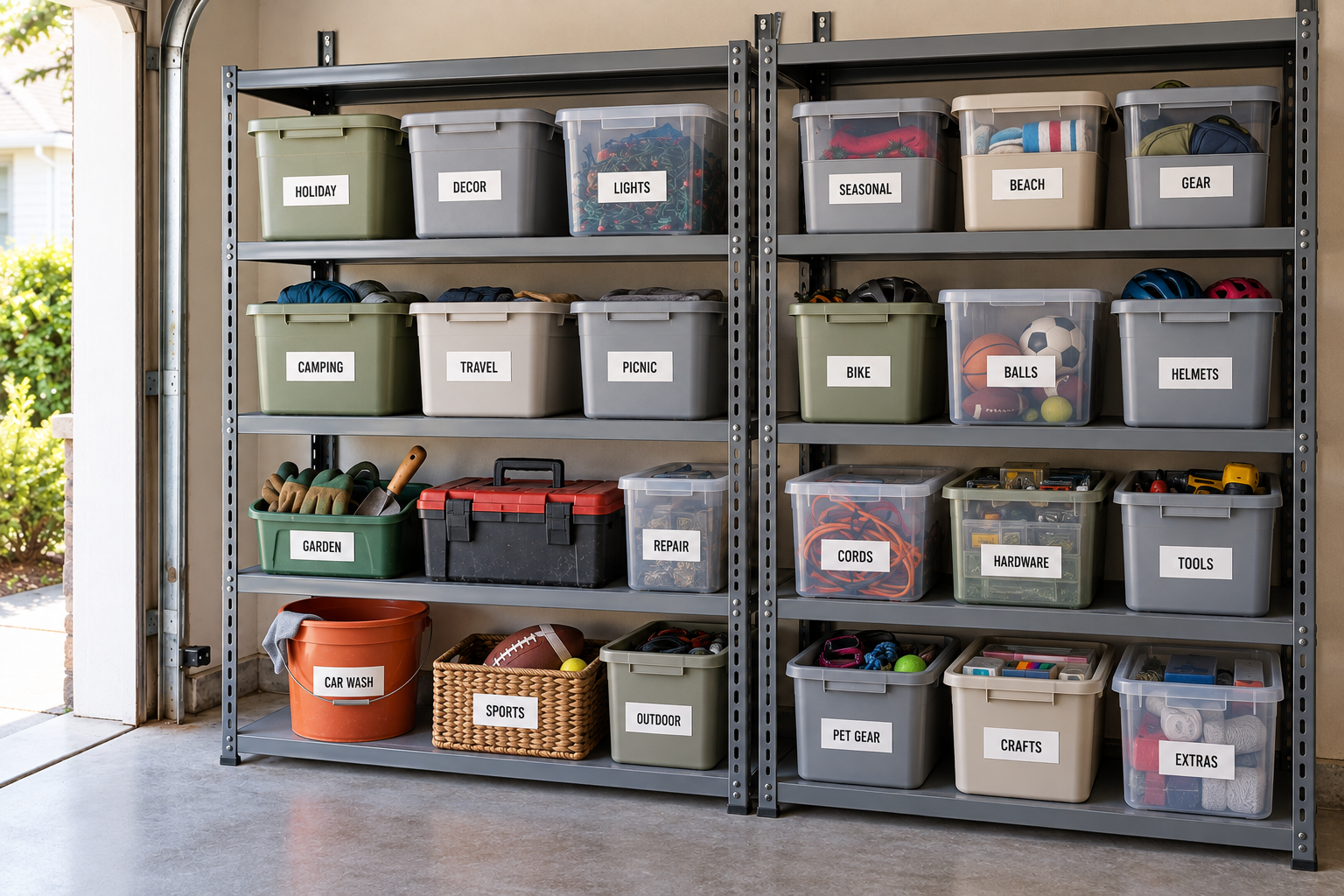
Within your chosen area, gather related items into understandable groups. Gardening hand tools, bicycle accessories, car-washing supplies, outdoor games, and holiday decorations are more useful categories than “garage stuff.”
Do not make the categories so precise that nobody can maintain them. A household that wants a simple repair kit may need one container for everyday hand tools, not separate systems for every shape of screwdriver. A frequent hobbyist may genuinely benefit from finer divisions.
Notice duplicates without treating them as automatic mistakes. Two pairs of gloves may be useful for two people. A second tape measure may belong in a separate working area. The question is whether the quantity supports actual use, not whether owning more than one violates an organizing rule.
Put incomplete sets together while you sort. A pump without its attachment or a tool without its case needs a decision. Find the missing part, record a repair task, or decide whether the item still belongs. Avoid returning every unfinished question to the shelf under a more attractive label.
Give the easiest storage locations to the things used most often. Frequently used equipment should not require shifting a stack of seasonal decorations. Heavy objects belong where they can be handled safely, within the equipment’s instructions, rather than where they make the arrangement look balanced.
Think through the journey of each category. Gardening supplies may work best along the route to the yard. A household repair kit may be more convenient near the door into the house. Sports bags may belong close to the place where the car gets loaded.
Keep incompatible activities separate. A snack basket does not belong beside chemicals just because both fit on the same shelf. Hazardous household products need their original labeled containers and storage appropriate to the label; the EPA’s household hazardous waste guidance explains why ordinary organizing rules are not enough for those materials.
You are designing a useful route, not simply placing every object against a wall. Test the route with the people who will use it.
An open container can be a great choice for sturdy items that need frequent, easy returns. A lidded container may suit compatible seasonal belongings that need protection from ordinary dust. Neither is automatically better. The job decides.
Try to avoid deep bins full of small, unrelated objects. Their apparent capacity can conceal the work required to retrieve anything. Smaller groups inside an existing larger container may solve the problem, provided the smaller containers are appropriate and do not make access awkward.
Keep the weight of a full container in mind. A giant tote packed with dense equipment can become difficult to move even when the tote itself is sound. You do not have to fill every available cubic inch to make storage efficient.
Matching containers are optional. Consistent meanings are not. Three different totes labeled “Outdoor lights,” “Winter table linens,” and “Garden hand tools” are more useful than three identical totes labeled “Miscellaneous.” Beauty is welcome here; confusion is not invited.
Imagine an existing shelf with a clear opening about 36 inches wide and 16 inches deep. This is an illustrative example, not a recommended shelf specification. On it sit a half-empty holiday tote, loose gardening gloves, a car-washing bucket, and a small toolbox.
First, identify what you use often. Suppose the gloves and washing bucket are weekly items, the toolbox is occasional, and the holiday tote is annual. The shelf is doing four jobs with no distinction between them.
Move the annual category to a suitable less-convenient location after checking its storage needs. Keep the car-washing supplies together in the existing bucket when their labels permit that arrangement. Put clean gardening hand tools and gloves in an existing open caddy. Give the toolbox a defined place that allows its lid to open safely.
Now retrieve and return each group. The improvement is not that the shelf holds more. It is that the shelf asks you to do less every time you need something.
Use words your household already uses. “Bike repair” beats a clever category name that only the person with the label maker understands. Large, readable lettering usually matters more than a decorative style.
Label the container and, when useful, the shelf location. A shelf label can help an empty container return to the right place. Keep labels easy to revise while the arrangement is new. A system that changes after a week is being adjusted, not failing.
For seasonal storage, add a short contents note only when the main category is not enough. “Outdoor lights: porch, front shrubs, extension accessories” may prevent several containers from being opened. A full item-by-item inventory is unnecessary for a bin of obvious, easily recognized objects.
Invite another person to find one item without coaching. Their hesitation is helpful information. Revise the label or location rather than explaining that they are supposed to remember what you meant.
* Affiliate disclosure: As an Amazon Associate I earn from qualifying purchases. Clicking these links is free. If you make a qualifying purchase, we may earn a commission at no extra cost to you.
The product links below open Amazon searches, not verified individual listings. Compare the current dimensions, materials, seller information, and instructions before choosing anything. These are storage ideas, not products claimed to have been personally tested.
Consider a clear box when a compatible category needs a lid and seeing the contents would save repeated searching. Choose its size around the shelf opening and the weight you can comfortably handle when it is full. A visible bin is not a guarantee against moisture, pests, or other storage hazards. Skip it when an existing suitable tote already does the job.
Explore clear latching storage boxes on Amazon (affiliate link*)
A removable label pocket or holder makes sense when several similar containers need clearer identities. Check how it attaches and whether it suits the container surface. Place it where it remains visible during storage, not only on a lid hidden beneath another tote. Handwritten cards work beautifully while categories are still being tested.
Explore removable bin label holders on Amazon (affiliate link*)
An open caddy can keep a small, frequently used group together and travel to the task. Look for a handle that remains usable when loaded and compartments that fit the actual tools. It should not become an overflowing toolbox substitute. Sharp tools, batteries, and other equipment still require the handling and storage their manufacturers specify.
Explore portable tool caddy on Amazon (affiliate link*)
After the first reset, write down the remaining problems in plain language. “The small sports accessories roll off the shelf” is a useful observation. “We need a better garage system” is too broad to shop from.
Live with the arrangement through a few normal uses. Perhaps a shallow basket fixes the small-item problem. Perhaps the category belongs elsewhere. Buying after that test gives you a better chance of purchasing one helpful thing instead of three hopeful things.
Include non-shopping actions on the list. An unwanted item may need a donation destination. A damaged shelf may need to be taken out of use. A household member may need a more reachable location. Those problems are not solved by adding another bin.
Store any measurements with the list. Future you deserves better than standing in a store trying to remember whether the shelf was “about this wide.”
No. Reuse is a starting preference, not an obligation. Keep storage that is sound, appropriate, and helpful. Damaged, unstable, inaccessible, or badly sized pieces may need replacement or removal. A free item can still be the wrong item for the job.
Revisit the volume and purpose of the belongings before adding storage. Identify which categories support your priorities and which could live more appropriately elsewhere. When access or safe handling is compromised, more containers may disguise the problem rather than solve it.
Yes. Complete one bounded area at a time and maintain usable routes between sessions. Record the next specific task before stopping. Progress may take several sessions, but a finished shelf can be useful immediately while the rest of the project continues.
End by putting away the sorting supplies, checking the walking route, and returning one everyday item to its new home. That small test is worth more than a dramatic photograph of everything temporarily lined up on the driveway.
You are allowed to create an ordinary, hardworking garage. It can contain beloved hobbies, muddy shoes, practical tools, and mismatched bins. The achievement is that those things support your life without making every errand a search expedition.
For hands-on garage organizing in Charlotte, Matthews, Mint Hill, and approved nearby communities, contact Garage Revisited to discuss your space and address. The work focuses on sorting, decluttering, and useful arrangements—not cabinetry, coatings, or structural installation.
Continue with Plan Your Garage Zones Before You Buy a Single Bin or How to Label Storage Bins So You Can Find Things Next Year.
You don’t need a perfectly tidy home—or a complete plan—to begin. Let’s talk about the space you’d like to reclaim and what would make everyday life easier.
Serving Matthews, Mint Hill, and nearby Charlotte communities.
Prepare for your first professional organizing session with practical tips on setting goals, discussing costs, and ensuring a productive experience.
Start decluttering an overwhelming home with one manageable area. Choose a useful goal, make clear decisions, and finish a small task without...
Discover a manageable weekly home reset routine that focuses on practical tasks, allowing you to maintain organization without overwhelming your...
YOUR NEXT STEP