7 min read
Organize School Papers and Kids’ Artwork Without Keeping Every Sheet
 Nikke the SpaceMaker
:
Published
Updated
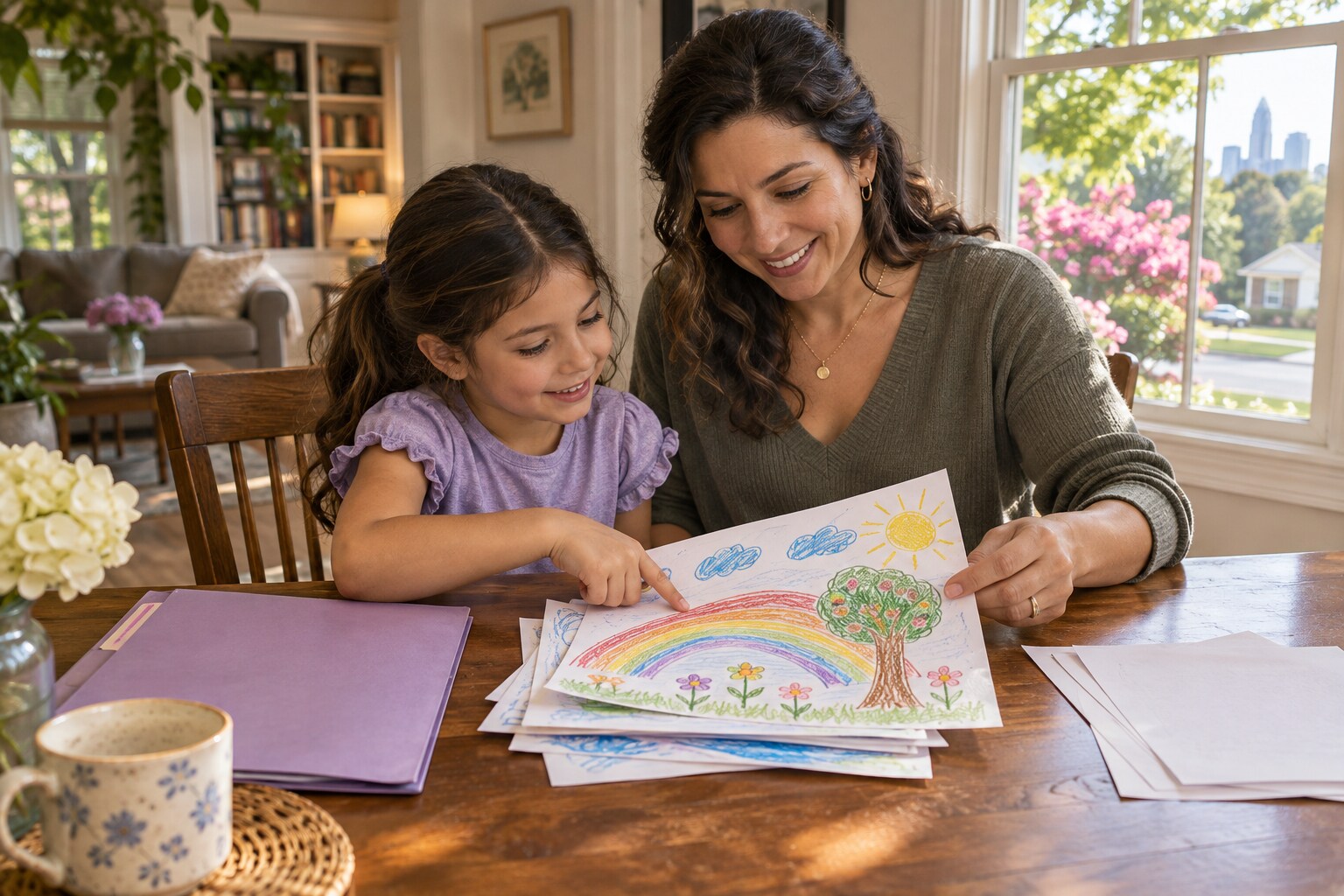
Keep the useful information and the meaningful memories while making room for the next beautiful batch.
Organize school papers and children's artwork by separating action papers from keepsakes, choosing a manageable review routine, and keeping selected memories in clearly identified storage. Let children participate in age-appropriate choices and preserve the information that gives a piece meaning. You can celebrate their work without keeping every sheet in the active household paper pile.
A school bag can contain an entire administrative department in miniature. There is a form to sign, a note to read, a drawing with an excellent purple creature, and a paper whose purpose is unclear but whose importance is being strongly implied.
Artwork adds a different kind of decision. You want to honor the effort and the person who made it. You may also want the kitchen counter back.
Those goals can coexist. The key is separating what needs action from what deserves memory, then giving each a thoughtful route. A permission form and a beloved painting should not have to compete for the same place under the fruit bowl.
Open the school bag into a process
Choose a practical moment and location for reviewing incoming school materials. The routine should fit the household rather than depend on a perfectly calm afternoon that rarely occurs.
Separate papers that require action from ordinary information and possible keepsakes. Read the actual instructions and deadlines rather than assuming all school papers can wait until a weekly review.
Record relevant dates and tasks in an appropriate maintained system, with the supporting paper in a clear location. A form's presence on the counter is not a reliable reminder when several other forms are likely to arrive.
Keep sensitive information private. Children's names, school details, identification information, and other personal data should not be displayed or shared casually in organizing photographs or public posts.
Give action papers a temporary working home
Choose a small folder or tray for current school actions, using clear labels when more than one child or institution is involved. The system should make the next task obvious.
Write the action in plain language: sign, review, return, schedule, or ask a question. “School stuff” is a category, but it does not tell anyone what needs to happen.
After the task is completed, move the paper to its appropriate next location or disposition based on the actual need. Do not keep every completed action in the active folder indefinitely.
For records with legal, educational, medical, or other specialized significance, confirm retention requirements with the relevant source or qualified professional. A general organizing routine should not decide those questions by appearance or age alone.
Let everyday artwork have a visible season
Choose a limited display area for current work, when the display method is appropriate for the item and household. The area might be a board, shelf, or another suitable location.
Make the display temporary by design. New work can replace older work through a friendly review rather than accumulating on every surface until the only remaining clear space is the ceiling.
Invite the child to choose what they want to display when appropriate. Their favorite may be the piece with a story you would not have guessed from looking at it.
A display does not have to be a permanent promise to retain the original forever. It can be a way to enjoy the work now and decide later whether it belongs in a keepsake collection, a digital record, or another appropriate route.
Review keepsakes in a manageable group
Choose a small group of possible keepsakes rather than opening every year's school collection at once. Review when you have enough time to make thoughtful choices and restore the materials afterward.
Look for pieces that capture a stage, a particular interest, a meaningful story, or the child's own preference. You do not need to preserve every worksheet to remember a school year.
Avoid choosing only the most polished work. A funny sentence, an early drawing, or a project connected to an important memory may matter more than a technically impressive page.
At the same time, you are allowed to keep pieces simply because you love them. The purpose is an intentional collection, not a formal assessment of artistic merit conducted by the household's newly appointed curator.
Record the story before it disappears
Add useful context in an appropriate way: the child's name, approximate age or school year, date when known, and a short note about the piece. Keep uncertainty honest rather than inventing details later.
Ask the child to explain the work when they are interested. A brief description can preserve meaning that the image alone does not reveal. The purple creature may have a name, a job, and a surprisingly complicated family history.
Use a separate note or suitable enclosure when marking the original could be inappropriate. Valuable, fragile, or unusual materials may need preservation guidance rather than ordinary office supplies.
Keep the notes brief enough that the routine remains realistic. A sentence can be enough. The goal is to preserve useful context, not create a documentation task so large that no artwork ever reaches its storage home.
Choose storage for the actual materials
Paper, photographs, three-dimensional crafts, and mixed-media projects may need different storage. A standard folder is not a universal solution for every school creation.
For paper-based family keepsakes, consult the National Archives' family-archives guidance when preservation matters. Appropriate materials, environment, and handling are separate from simply keeping the collection in order.
Avoid folding or compressing a piece merely to fit a container you bought before measuring. Choose a suitable size for the retained work and keep the collection manageable.
For bulky projects, consider whether the original is practical to retain, whether a photograph would preserve what you value, or whether another approach is better. This is a personal choice. A photograph can be useful without being declared an equivalent replacement for every meaningful object.
Make digital copies searchable rather than anonymous
When photographing or scanning selected work, choose clear filenames and a consistent location. Include enough context to identify the child and occasion while protecting privacy in any shared version.
Check that the image is complete and readable before treating the task as finished. Store and back up digital material appropriately rather than assuming a single phone photo is a permanent archive.
Do not discard an original automatically after digitization. The National Archives' digitization guidance explains that digital files have their own preservation risks and that originals deserve careful handling.
Keep the digital project limited to material you actually want to preserve or share. Photographing every paper without a retrieval plan can create a second overwhelming collection, this time one that hides inside a device instead of a closet.
Include children without making every decision heavy
Offer age-appropriate choices and a manageable number of items. Asking a child to select favorites from a small group may be easier than asking them to decide the future of every drawing they have ever made.
Respect the difference between enjoying a piece now and wanting to store it indefinitely. Preferences can change. A gentle review process can leave room for that without making the child feel their work was unimportant.
Avoid surprise disposal of clearly valued pieces. A shared understanding of display, review, and keepsake storage can reduce conflict and uncertainty.
Keep the process conversational. “What would you like to remember about this?” invites a story. “Which of these are worth keeping?” can sound like an evaluation the child did not ask for. The language can make the practical task feel more respectful.
A hypothetical school-paper routine
Imagine a household with two children whose papers collect on the kitchen table. Forms, newsletters, artwork, and completed worksheets are mixed together, so important actions are difficult to identify.
The household creates a small incoming review point and separate action folders. Dates and tasks move into the appropriate reminder system. Selected current artwork receives a limited display area.
At a manageable review, each child helps choose a few meaningful pieces for an appropriately stored keepsake group. Context is recorded, and a few bulky projects are considered for photographs rather than automatic long-term storage.
The household still keeps memories. It simply stops asking the active paper pile to perform every job at once. The table becomes available, and the school form no longer has to hide beneath a very enthusiastic watercolor.
Three product types to compare
* Affiliate disclosure: As an Amazon Associate I earn from qualifying purchases. Clicking these links is free. If you make a qualifying purchase, we may earn a commission at no extra cost to you.
These Amazon links open searches, not verified individual listings. Review actual dimensions, materials, preservation claims, care requirements, and current seller information. Choose products according to the retained materials and the role each category serves.
An artwork portfolio
A portfolio can keep a selected group of flat work together when the size and materials are suitable. Measure the largest pieces before buying and avoid overfilling. Check whether the portfolio is intended for temporary transport, everyday storage, or preservation needs. Those are different uses, and a product label should not be assumed to cover all of them.
Explore artwork storage portfolio on Amazon (affiliate link*)
Hanging file folders
Folders can separate current school actions or ordinary reference categories in a suitable filing location. Use clear names and keep the active group small enough to review. They are not automatically appropriate archival enclosures or secure storage for sensitive information. Choose the surrounding storage according to the documents' actual needs.
Explore hanging file folders on Amazon (affiliate link*)
An archival document box
A suitable box may support a curated collection of paper keepsakes. Verify material specifications and size rather than relying only on marketing language. Avoid bending, crowding, or storing the box in an unsuitable environment. For valuable or delicate originals, consult preservation guidance before selecting enclosures or handling methods.
Explore acid free document storage box on Amazon (affiliate link*)
Keep the yearly review smaller than a yearly mountain
A school-year review is easier when action papers have already moved through their process and current artwork has been reviewed in small groups. You are then refining a collection, not confronting every sheet at once.
Choose categories that remain understandable across years. A simple child-and-year structure may be enough, with a separate location for records requiring specific retention.
Do not feel obliged to fill every compartment in a keepsake box. Empty space can remain empty. The container should hold chosen memories rather than create a quota of material to preserve.
Record where the collection lives and keep the labels current. A carefully selected box is more enjoyable when the household can find it without opening several nearly identical containers labeled “kids.”
Protect the memories from becoming a household burden
Keep the collection at a scale you are willing and able to care for. That may be larger or smaller than another family's collection, and it can change over time.
Do not assume that a future adult child will want every item. Invite preferences when appropriate, while making present storage decisions responsibly. Keeping something can be your own choice rather than a promise about another person's future interest.
A meaningful collection includes context and access, not only volume. A few well-identified pieces may tell a story more clearly than a large mixed box nobody wants to sort.
The point is to make room for memory and current life together. The child gets to keep creating, the household gets a workable paper routine, and the refrigerator door does not have to carry the entire archive.
Questions about school papers and artwork
Do I need to keep every school paper?
No general organizing rule requires that. Separate ordinary work from records with specific retention needs, and confirm specialized requirements with the appropriate source. Choose keepsakes intentionally rather than retaining every sheet by default.
How many pieces of artwork should I keep?
There is no universal number. Consider meaning, the child's preferences, suitable storage, and the effort you can give the collection. A manageable intentional group is more useful than a numerical target chosen without reference to your family.
Is photographing artwork a good alternative?
It can be useful for selected pieces, especially when size makes storage difficult. Preserve context, check image quality, and manage the digital files appropriately. The choice to retain the original remains separate and should reflect the item's significance and needs.
Keep the story, not the whole paper avalanche
Start with one week's incoming papers or one small artwork group. Give actions their next steps and memories their own thoughtful place. The two categories will be much happier when they are no longer sharing a pile.
For hands-on home and paper organizing in Charlotte, Matthews, Mint Hill, and approved nearby communities, contact Space Revisited to discuss your project and confirm coverage. There is room to celebrate the purple creature and still find the permission form before it is due.
Related reading
Continue with Decluttering Sentimental Items With a Gentle Heart or A Home Paperwork System for Mail, Forms, and Follow-Ups.
About Space Revisited
Space Revisited helps homeowners in Charlotte, NC, and surrounding communities create beautiful, functional, and easy-to-maintain spaces. From decluttering and home organizing to practical storage solutions and complete space transformations, we help you make room for what matters.
About Garage Revisited
Garage Revisited by Space Revisited helps homeowners throughout the Charlotte, NC, area reclaim their garages and workshops. From decluttering and cleaning to shelving, storage systems, and functional workspace makeovers, we transform underused spaces into organized environments that work for everyday life.
A little help getting started?
You don’t need a perfectly tidy home—or a complete plan—to begin. Let’s talk about the space you’d like to reclaim and what would make everyday life easier.
Serving Charlotte's metropolitan communities.
YOUR NEXT STEP