7 min read
Where to Start Unpacking: One Useful Room at a Time
 Nikke the SpaceMaker
:
Published
Updated
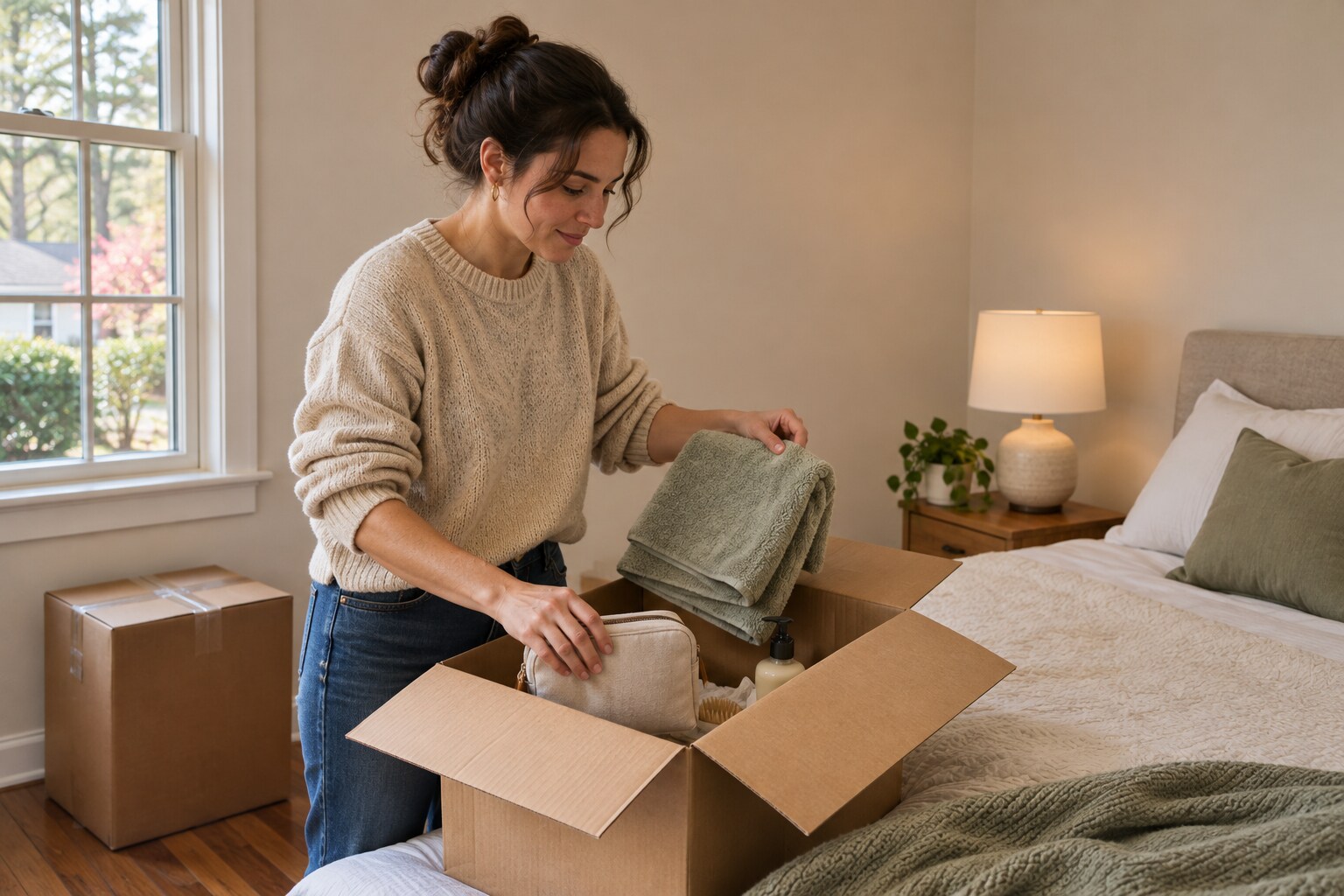
Find the bed, the bathroom, and tomorrow’s essentials before you worry about the perfect bookshelf.
Start unpacking by making essential daily functions usable: clear access, a place to sleep, a working bathroom, appropriate food storage, and the belongings needed for the next day. Then complete one manageable zone at a time. Temporary homes are fine when they are clearly identified and reviewed; opening every box at once usually creates more decisions than it resolves.
The truck has gone. The boxes have stayed. Somewhere in this cardboard landscape are your pajamas, a phone charger, and the particular mug that makes a new place feel slightly less unfamiliar.
It is tempting to judge progress by how many boxes you empty. But an empty box can simply mean its contents are now spread across three surfaces. Let’s use a more generous and useful measure: what can your household do comfortably tonight that it could not do this morning?
You do not need a fully styled home to begin living in it. A usable corner, a clear route, and a few thoughtful priorities can make the first days feel much more manageable.
Begin with the people, not the room names
Ask what each household member needs immediately and over the next day. Work schedules, school needs, care routines, accessibility, and pets can change the unpacking order.
A person working from home tomorrow may need a small functional work area before decorative objects are unpacked. Someone with specific equipment or care requirements may need an appropriate setup before ordinary storage decisions begin.
Follow specialized instructions and obtain qualified help for needs beyond organizing. The priority list should reflect actual life, not a universal sequence that assumes every household has the same schedule, mobility, or resources. Write the first few essentials down so they remain visible when boxes begin competing for attention.
Protect routes before creating work piles
Look at the movement required through the home: entrances, exits, stairs, doors, and access to essential equipment. Keep these areas clear and avoid making temporary sorting stations that block them.
Choose one appropriate opening area for boxes. Keep packaging contained as you work and move it through the correct disposal or recycling route when practical. Do not allow the empty boxes to become a second obstacle course.
A clear route is useful progress even when many belongings remain packed. It lets the household function while the project continues. Do not climb unstable stacks or move awkward loads alone simply to make the room look farther along.
Make the first night workable
Identify sleeping essentials, bathroom necessities, current clothing, and appropriate food and drink arrangements. Locate the items needed to complete those functions rather than unpacking every related category.
For example, a bedroom can become usable before the entire dresser is arranged. A bathroom can serve its immediate purpose before every reserve product has a permanent shelf.
Keep important documents, medicines, and specialized items under appropriate handling and storage arrangements. Do not bury them in a general “first night” basket without considering their needs. The goal is a sensible first-night setup that supports the people using it—not an aesthetically coordinated collection of essentials.
Create a small command point
Choose one modest place for ordinary move notes, a room list, a pen, and the next few actions. Keep sensitive information appropriately protected rather than displaying it as part of the organizing system.
Record issues that need follow-up: a missing box, a product manual to consult, or a measurement to take. Assign a next action rather than relying on the pile itself to remind you.
This station should remain small. It is a place to coordinate the move, not a new household junk drawer with a temporary address. At the end of a session, update the next tasks and remove papers that no longer belong there.
Open a box for a purpose
Before opening a box, identify what function it will help complete. Kitchen basics, current clothes, and active work materials are different priorities from display objects or reserve supplies.
Read the label and place the box near its actual destination when that can be done safely. Open it where there is enough appropriate working space, then deal with the contents in manageable groups.
Do not force unrelated items into the nearest cabinet just to empty the box. If an object belongs elsewhere, give it a clearly identified transfer route. A little destination discipline now is easier than wondering later why the printer paper lives beside the soup bowls.
Finish a zone, not necessarily an entire room
A zone is a defined function with the things needed to use it. The bedside area, a basic meal-preparation space, or a small working desk can be completed before the surrounding room is fully arranged.
For each zone, decide what belongs, where it goes, and how it returns after use. Test the setup with an ordinary task. Can you get dressed, make a simple meal, or start the workday without searching through another pile?
This approach creates usable islands of order without requiring enormous sessions. It also gives you feedback before you fill every available space. A cabinet arrangement that looks plausible may prove awkward after one actual meal.
Use temporary homes honestly
Some decisions should wait until you understand the new space. Temporary placement is reasonable when it is safe, bounded, and easy to identify.
Give the temporary category a clear name and a review cue. “Extra kitchen utensils: review after several meals” is more useful than an unlabeled box pushed into a closet. Avoid combining every uncertain item into one enormous waiting category.
Keep temporary storage out of important routes and do not use unsuitable environments merely because space is available. Temporary does not mean exempt from material, product, or safety requirements. The purpose is to allow learning without creating a second long-term mystery-storage system.
Let the new home be different
Your previous layout was built around different rooms, cupboards, and routines. Recreating it automatically can make the new home work harder than necessary.
Notice where activities naturally happen. Which entrance do you use? Where do groceries arrive? Where is the comfortable place to sort paperwork? Which storage is easy for the intended person to reach?
Use those observations to refine placement. A familiar arrangement may still work beautifully, but let it earn its place. You are not obligated to keep the old system simply because you remember where everything used to go. This home is allowed to teach you something new.
A hypothetical first-week sequence
Imagine a household arriving with two adults, a child, and a dog. Their first priorities are clear routes, sleeping arrangements, bathroom supplies, appropriate pet essentials, and food storage. One adult needs a basic work setup the next morning.
They complete those functions before opening display and hobby boxes. Next, they establish a usable kitchen zone and current clothing storage. School materials receive a defined home because they will be needed soon.
Later sessions handle reserve supplies and less urgent categories. This is not a prescribed schedule or a promised timeline. It illustrates how actual needs can set the order. Another household might prioritize very different functions, and that would be entirely sensible.
Three optional products that can support unpacking
* Affiliate disclosure: As an Amazon Associate I earn from qualifying purchases. Clicking these links is free. If you make a qualifying purchase, we may earn a commission at no extra cost to you.
These are ordinary Amazon search links for product categories, not verified product listings or tested recommendations. Existing labels, baskets, or suitable containers may already do the job. Check current dimensions, materials, instructions, and seller information before purchasing.
Open-first moving labels
Large readable labels can identify boxes containing immediate-use items or distinguish the next unpacking group. Use words that explain the contents and destination rather than assuming a color will be understood by everyone.
An “open first” label works best when used selectively. If every box receives one, the priority system has quietly resigned. Choose surface-compatible labels and follow instructions; do not attach them to valuable or delicate finishes without checking suitability.
Explore open first moving labels on Amazon (affiliate link*)
Portable household caddy
A lightweight caddy can keep appropriate everyday unpacking supplies together. Select a size you can handle comfortably and use separate, suitable storage for items with specialized or hazardous handling needs.
The caddy's value is reducing repeated searches for ordinary supplies, not carrying the entire move. Give it a parking place, return its contents after use, and retire the temporary role when the home no longer needs a roaming unpacking station.
Explore portable household caddy on Amazon (affiliate link*)
Reusable room-sorting baskets
A few manageable baskets can temporarily separate items that belong in another room. Label the destination and complete the transfer before the basket becomes a permanent collection point.
Choose shapes that fit the intended use without obstructing access. Avoid heavy loads, unstable stacking, and oversized baskets that encourage indiscriminate dumping. One small basket with a clear destination can be more useful than a matching set with no agreed purpose.
Explore reusable room sorting baskets on Amazon (affiliate link*)
Give each session a closing routine
Leave time to put appropriate tools and supplies away, contain packaging, clear the working surface, and restore access. A session should end in a state the household can live with.
Write the next small task before stopping. “Unpack the current drinking glasses into the lower cabinet” is easier to resume than “finish kitchen.” Specificity reduces the need to reconsider the whole project every time you return.
Do not use the final minutes to open one more complicated box. That is often how a satisfying session becomes an unfinished evening. Ending with a usable zone is a more helpful achievement than squeezing in a dramatic final burst of cardboard opening.
Review the boxes that keep waiting
After immediate needs are working, look at what remains unopened. Some boxes may contain genuinely lower-priority belongings. Others may represent uncertain placement, an unwanted category, or a task that needs another person's input.
Identify the reason before choosing the next action. A box waiting for a shelf measurement needs a measurement. A box of shared memories needs a conversation. A box you no longer want needs an appropriate exit plan.
Do not assume everything left packed is unnecessary. Equally, do not grant it permanent storage simply because it survived the move. Give the remaining categories deliberate attention so the final stage is a series of understandable decisions rather than a vague obligation hanging over the home.
Make asking for help specific
When someone offers to help, choose a task with a clear boundary and explain what decisions remain yours. Unpacking already selected towels into an agreed location is different from deciding which family belongings should be discarded.
Show the helper where packaging goes, which boxes should remain closed, and what to do with uncertain items. A simple question area can prevent well-meaning guesses from scattering belongings through the house.
Agree on a stopping point and leave time for a walkthrough. Review the completed area together so you know what changed. Useful help should leave you with a more understandable home, not a faster-moving version of the same mystery. You are allowed to accept assistance while keeping control of personal decisions.
Questions about where to start unpacking
Should I finish one whole room before touching another?
Not always. Essential functions may be spread across several rooms. Establish those first, then work through manageable zones. Once the household can function, completing a defined area helps reduce scattered piles and makes later decisions easier to track.
How long should unpacking take?
There is no universal timeline. The volume of belongings, available help, daily responsibilities, access, and complexity of decisions all matter. Use functional milestones rather than comparing your home with someone else's moving story or promising yourself an unrealistic finish date.
Should I buy storage containers before unpacking?
Usually, wait until you know what needs a home and have measured the actual space. Reuse suitable storage temporarily. Buying for imagined categories can leave you with containers that fit neither the new cabinet nor the belongings you decide to keep.
What if I find things I no longer want?
Keep them separate from the retained categories and arrange an appropriate donation, sale, recycling, or disposal route. Confirm current acceptance requirements. Do not simply create a new unwanted-items corner that becomes part of the room's permanent layout.
Build a home you can live in while you finish
Choose the next useful function, unpack what supports it, and leave the space ready for ordinary life. Repeat at a pace that fits your household, with clear priorities and manageable stopping points.
For hands-on unpacking and home-setup organizing in Charlotte, Matthews, Mint Hill, and approved nearby communities, contact Space Revisited to discuss your project and confirm coverage. Transport, installation, and specialized work are separate services unless explicitly arranged. You do not have to uncover the whole house today. Start by making one part of it feel like yours.
Related reading
Continue with Declutter Before Moving: A Practical Order for What Comes Next or How to Unpack a Kitchen in a Sensible Order.
About Space Revisited
Space Revisited helps homeowners in Charlotte, NC, and surrounding communities create beautiful, functional, and easy-to-maintain spaces. From decluttering and home organizing to practical storage solutions and complete space transformations, we help you make room for what matters.
About Garage Revisited
Garage Revisited by Space Revisited helps homeowners throughout the Charlotte, NC, area reclaim their garages and workshops. From decluttering and cleaning to shelving, storage systems, and functional workspace makeovers, we transform underused spaces into organized environments that work for everyday life.
A little help getting started?
You don’t need a perfectly tidy home—or a complete plan—to begin. Let’s talk about the space you’d like to reclaim and what would make everyday life easier.
Serving Charlotte's metropolitan communities.
YOUR NEXT STEP